

by Miriam G. Desacada
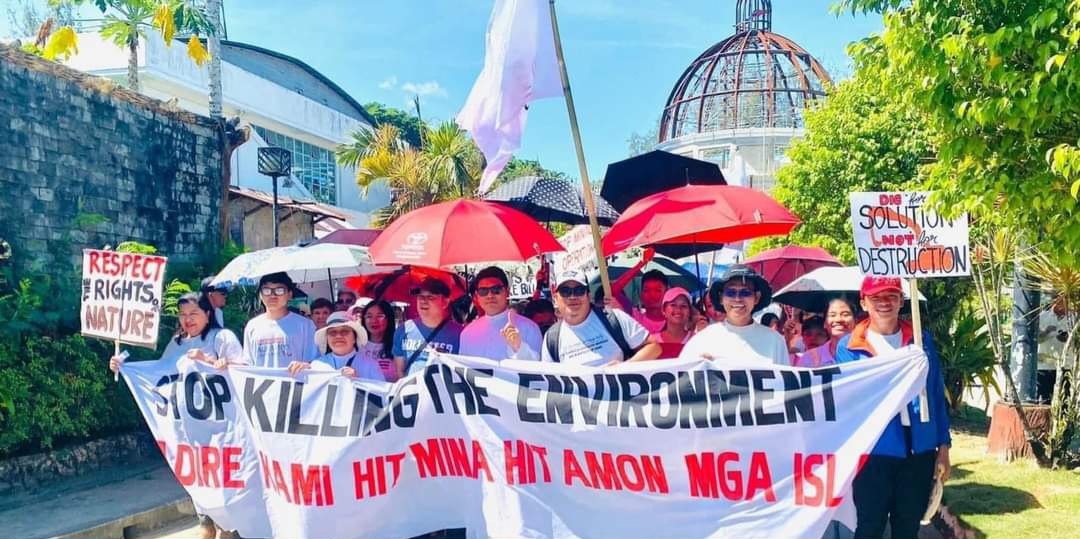
Borongan City–Thousands of people from Leyte and Samar islands on Saturday converged at a church in Guiuan, Eastern Samar to resume their protests against large-scale mining at Homonhon, which they said had destroyed the environment and the community of this island that is part of Guiuan town.
The Catholic Church and environmental advocates have been openly protesting for years against mining by multi-national companies for nickel and chromite in the island, and have been pleading the government and its officials to act on this matter but only to fall on deaf ears.
Reverend Father Antonio Alconaba, team ministry head of the Homonhon parish, welcomed the protesters that gathered at the Immaculate Concepcion Church in Guiuan where they voiced their sentiments again on the destructive mining activities in the island.
Alconaba said this environmental issue is not just for the people of Eastern Samar but for all, including those from other places, because of the critical and urgent need to save and preserve the environment for the common good.
Homonhon parish priest, Rev. Fr. Jonathan Pading, said mining should not be allowed in Homonhon because it direly affected the lives of the people there, their sources of water and their livelihood, not to mention the divisive nature of the issue between the pro-mining and anti-mining groups.
Through the years as a parish priest, Pading said mining has never been good to the communities in the island contrary to the promise of economic development for the people that never came anyway.
Aivan Herzano, project officer of Philippine Misereor Partnership Inc. (PMPI), which had been supporting the protests spearheaded by the three Dioceses of Samar, together with Caritas Pilipinas, highlighted the importance of action to protect the environment due to the continuing biodiversity loss and climate crisis.
Herzano added that the Rights of Nature must be judicially recognized and fought in courts because nature also needs to be preserved and protected like humans.
PMPI is a social development and advocacy network consisting of more than 230 NGOs, Pos, and faith-based groups nationwide working for justice, peace and rights of nature, while Caritas Pilipinas is the humanitarian, development, and advocacy arm of the Catholic Bishops Conference of the Philippines (CBCP).
National bills had been filed in Congress, and local ordinances enacted in at least three towns in Eastern Samar regarding these calls for environmental advocacy but it seemed all efforts may come to nothing, considering that pro-mining groups emphasized financial returns that will trickle down to the economic condition of the island.
Eastern Samar lone district Representative Ben Evardone could only say he has been pushing for responsible mining, which means that the economic benefits from mining can be sustained but measures to protect the environment must also be strengthened.
Guiuan town Mayor Annaliz Kwan, who attended the prayer rally at the church, said she is also for responsible mining because mining itself generates employment and boost income to the LGUs but then it must be done with the assurance that the environment shall not be totally damaged.
Most Rev. Bishop Crispin Varquez of the Diocese of Borongan, who for years had been expressing serious concerns over the “very disturbing” escalating mining activities in Homonhon, said the government must give importance to nature and people rather than profits by finding cleaner alternatives to support the basic demands of the community and enhance the economy at the same time.
Varquez also challenged the faithful to live a simple lifestyle and to be stewards of the environment by protecting the environment proactively as they go through their everyday lives.
With the looming outcome that mining activities in Samar may further intensify based on reports to re-classify even the major protected areas in Samar and declare it as multipurpose land, the Bishop said they will step up their campaign and engage in high-level discussion with top government officials regarding the issue of mining.
The immediate and negative effects of mining to the communities are very alarming, said Varquez. “We call on our government leaders to take action on this,” he told the media in the past. —Miriam G. Desacada